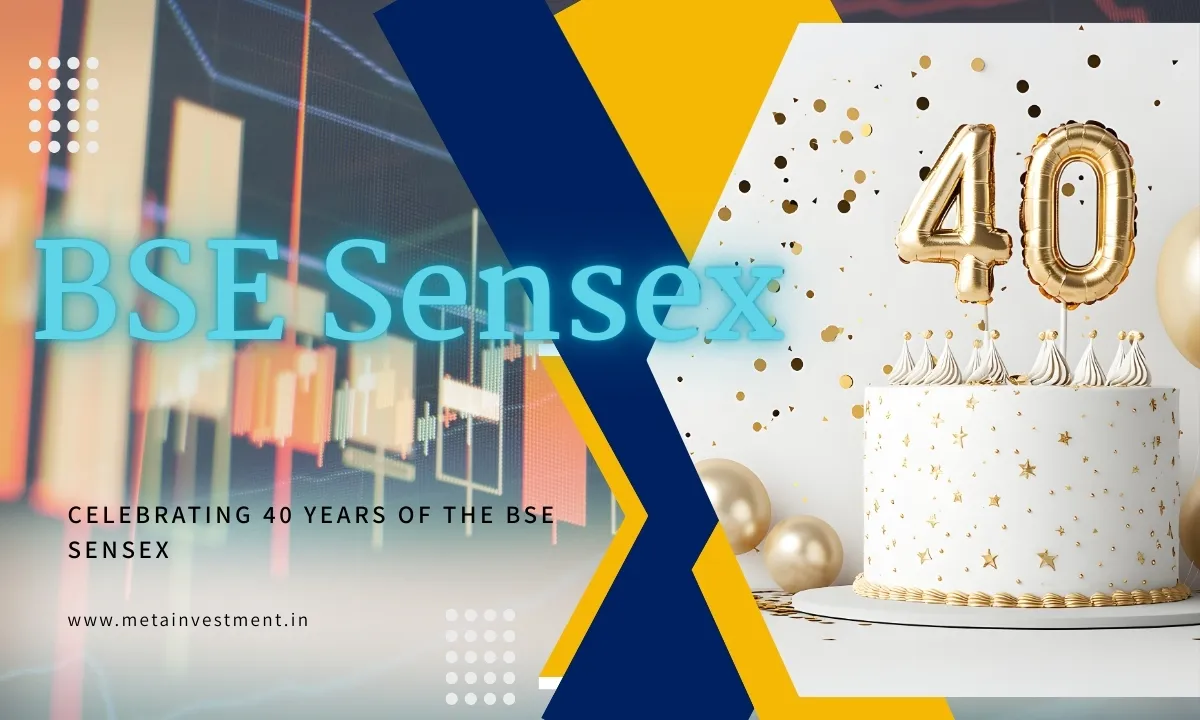
The BSE Sensex turns 40 today – and its story is a powerful lesson for every Indian investor. What began at 549 points in 1986 now stands above 85,000, delivering ~13–13.4% annual returns and a staggering 15,594% total growth.
This isn’t just a market milestone; it’s proof that simple, disciplined index investing has quietly built generational wealth.
If you had invested ₹1 lakh at the Sensex’s launch, it would be worth roughly ₹1.57 crore today – no stock-picking, no timing the market, just riding India’s growth.
What is Sensex?
Sensex, short for Sensitive Index, is the BSE’s flagship benchmark tracking 30 of India’s largest, most liquid large-cap companies listed on the Bombay Stock Exchange. Launched January 2, 1986 (base 100 on 1979), it serves as the “pulse” of India’s equity market, reflecting economic health via free-float market-cap weighting.
Component selection
The S&P BSE Index Committee selects/reviews constituents semi-annually using strict criteria:
- Listed on BSE with high free-float market cap (large/mega-cap).
- Superior liquidity (high trading volume).
- Revenue from core business, financial viability.
- Sector balance mirroring broader Indian market (financials ~30%, IT ~14%, energy/telecom ~10–12% each).
Rebalancing process
The SENSEX is reviewed Semi-Annually (twice a year) by the BSE Index Committee (part of BSE Index Services). The primary criteria for a stock to stay or enter are:
-
Market Cap: It must be among the top companies by “Free-Float Market Capitalization.”
-
Liquidity: The stock must be easy to buy and sell (high trading volume).
-
History: It must have a listing history (usually at least 6 months) and a track record of being traded on most days.
Rebalancing Date
Rebalancing dates follow a specific pattern rather than a single unchanging day every year:
-
Frequency: Twice a year—in June and December.
-
Effective Date: The changes usually take effect on the Monday following the third Friday of these months.
-
Announcement: The BSE usually announces which stocks are being added or removed about 4 weeks in advance. This gives the market time to prepare.
Example (2025):
- The June rebalance became effective on June 23, 2025.
- The December rebalance became effective on December 22, 2025.
Why the “Set-and-Forget” Sensex Strategy Worked So Well
The success of passive investing in the Sensex boils down to three powerful drivers:
-
Automatic Rebalancing: The index naturally promotes growing leaders and phases out laggards.
-
India Growth Proxy: Its returns closely mirror India’s nominal GDP growth, effectively taxing the country’s economic progress.
-
Behavioral Edge: Low-cost index funds through SIPs reduce the urge to make emotional, costly decisions during volatility.
For millions watching the Sensex ticker on TV, this is validation: owning the market through a simple SIP has been one of India’s most reliable wealth machines.
A Quick History: Bringing the Sensex to Every Investor
The HDFC Index Fund - Sensex Plan (launched July 2002) was the first mutual fund to let retail investors own the Sensex directly. ETFs like the ICICI Prudential S&P BSE Sensex ETF (2003) followed, making passive investing accessible to all via SIPs or lumpsum.
But the Index Alone Isn’t the Full Story
The Sensex consists of only 30 large-cap stocks. India’s true growth story extends into thousands of small and mid-cap companies, where active fund managers have historically captured explosive opportunities.
This isn’t about choosing between active or passive—it’s about blending them. Veteran active equity funds with 25–30 year track records have often delivered an extra 3–5% CAGR over the Sensex, turning the same ₹1 lakh into ₹20–25 lakh over 25 years, compared to the index’s ~₹10–12 lakh.
The Proof: Active Funds That Have Consistently Beaten the Sensex
Here are funds with proven long-term track records, showcasing the “alpha” from skilled stock selection:
| Fund Name | Inception | ~25-Year CAGR | Category | Key to Outperformance |
| HDFC Top 100 Fund (G) | 1996 | 18.86% | Large Cap | Quality large-cap focus & bull market execution |
| ICICI Pru Multicap Fund (G) | 1993 | ~17%+ | Multi Cap | Balanced, all-weather approach across market caps |
| Franklin India Prima Fund | 1993 | ~17% | Mid Cap | Early identification of high-growth mid-cap companies |
| SBI Magnum Midcap | ~1993 | ~16–17% | Mid Cap | Value-driven approach excels in recoveries |
| UTI Mastershare Unit Scheme | 1986 | ~15–16% | Large Cap | Steady, disciplined process from India’s oldest funds |
Data based on long-term performance trackers. Past performance is not a guarantee of future results.
These funds represent the top quartile of long-term survivors, demonstrating that skilled active management adds value where pure indexing cannot—especially in identifying smaller winners and managing risk.
Your Balanced Blueprint: The Core-Satellite Strategy
Think of your portfolio like a marathon relay:
-
The Core (Your Anchor – 50-70% of equity): 2-4 actively managed funds from proven categories:
- A large-cap/flexi-cap fund (e.g., HDFC Top 100) for stable yet outperforming core holdings.
- A multi-cap or mid-cap fund (e.g., ICICI Pru Multicap or Franklin Prima) for growth acceleration.
-
The Satellite (Your Sprinters – 20-50% of equity): A low-cost Sensex or Nifty 50 Index Fund. This ensures you capture the market’s baseline growth effortlessly.
The Power of Blending: A SIP Example Assume a ₹10,000 monthly SIP for 25 years:
-
Pure Index (13.4% CAGR): ~₹1.3 Crore
-
50/50 Blend (15% CAGR): ~₹1.6 Crore
-
Active-Heavy (17% CAGR): ~₹2 Crore
That extra 3-4% CAGR can fund a bigger home, a child’s foreign education, or an earlier retirement.
Lessons from 40 Years for Today’s Investor
-
Patience Over Prediction: The market rewards consistent investing far more than perfect timing.
-
Diversify Your Strategy: Blend index discipline with active opportunities to maximize returns and minimize blind spots.
-
Start Now, Build Smart: If you’re beginning, start a Sensex SIP today. Then, systematically allocate a portion (30-70%) to battle-tested active funds. Choose funds with a 10+ year proven process, not just last year’s winners.
Your Portfolio Checklist:
Sensex at 40 teaches us that wealth is built through endurance. The smartest strategy isn’t the most complex one—it’s the balanced one: letting the index compound your foundation while selectively allowing skilled managers to add that crucial edge for your future goals.
Sensex launched on January 2, 1986, at around 549 points. Turning 40 on January 2, 2026, marks 40 years of tracking India's top 30 companies, with ~13.4% annualised returns and 15,594% total growth.
No fund matches the full 40-year period, but 25+ year veterans like HDFC Top 100 Fund (~18.9% CAGR since 1996) and ICICI Pru Multicap (~17% since 1993) have outperformed Sensex's 13–13.4%.
HDFC Index Fund - Sensex Plan launched December 9, 1999, as the first mutual fund. First Sensex ETF was ICICI Prudential S&P BSE Sensex ETF on January 10, 2003.
Automatic rebalancing to winners, mirrors GDP growth (~13%), and behavioural simplicity reduce costly mistakes over decades.
Use core (50–70%) as active funds like HDFC Top 100 or Franklin Prima for mid/small-cap alpha and flexibility (~17% long-term CAGR) and satalite like Sensex or Nifty index.
Roughly ₹1.57 crore at 13.4% CAGR, showcasing India's equity wealth creation without stock-picking.